Overview: Layer 2 switching technologies. Understanding layer 2 is the foundation of building a high level understanding of switching. Many problems can be solved at layer 2 alone. My role is to help in explaining the technology so you are adequately equipped to solve these issues.
Technical details: We will look at STP, etherchannel, CDP, LLDP, vlans, and MAC addresses. We will cover definitions, common issues and troubleshooting steps. As a Senior Network Engineer, you will be expected to have a solid understanding of these technologies and be able to provide a professional analysis and resolution to any problems found here.
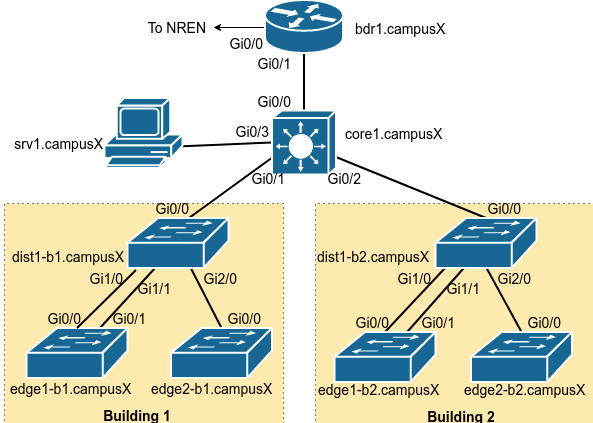
Spanning Tree Protocol (STP / RSTP / MSTP): Prevents network loops in redundant switched topologies by blocking redundant paths. [1]
VLAN Trunking Protocol (VTP): Synchronizes VLAN configurations across multiple Cisco switches in a management domain. [1]
Cisco Discovery Protocol (CDP): A proprietary protocol used to share information (device ID, software version, IP address) about directly connected Cisco equipment. [1]
Dynamic Trunking Protocol (DTP): Negotiates trunking links automatically between Cisco switches.
Port Aggregation Protocol (PAgP): A Cisco-proprietary protocol used to bundle multiple physical ports into a single logical channel (EtherChannel).
802.1Q: The open standard IEEE method for frame tagging and VLAN trunking.
Link Layer Discovery Protocol (LLDP): An open standard alternative to CDP used for discovering neighboring network devices.
Link Aggregation Control Protocol (LACP / IEEE 802.3ad): An open standard protocol for bundling Ethernet links.
Unidirectional Link Detection (UDLD): Detects physical link failures, particularly unidirectional link faults on fiber pairs. [1, 2, 3, 4]